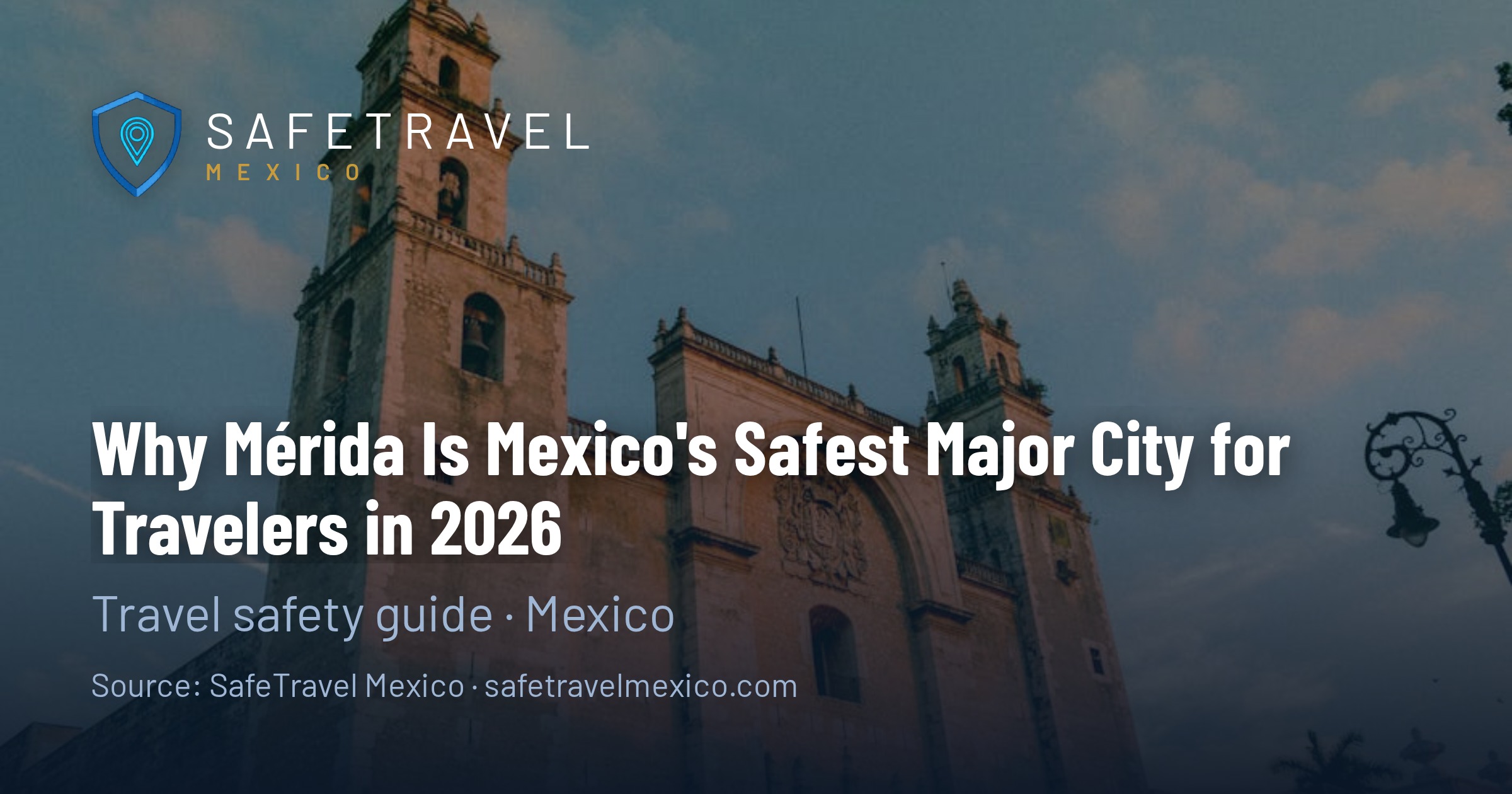
Why Mérida Is Mexico's Safest Major City for Travelers in 2026
🔒 Safety Score Mérida Before You Book
Get your personalized risk report + 50% OFF with code MAYO50 · Start Free Assessment
Why Mérida Is Mexico's Safest Major City for Travelers in 2026
When US travelers search "safest city in Mexico," they usually end up with a list dominated by beach destinations — Tulum, Sayulita, Huatulco — or generic "feel-good" blog posts that don't cite a single number. The result is a false equivalence between a sleepy surf town and a fully functioning major city with international hospitals, a real airport, and a year-round expat community.
There is one major Mexican city — population over 900,000 — that consistently outranks every other major city in the country on the metrics that actually matter: crime statistics, advisory levels, and infrastructure. That city is Mérida, capital of Yucatán.
This guide explains why the data points to Mérida, what the numbers actually show, and how to plan a trip there with confidence in 2026.
---
The Headline Numbers
- Population (metro): ~1.3 million (city proper ~921,000)
- SESNSP homicide rate (2025): among the lowest of any Mexican state capital
- US State Department advisory level: Level 1 — Exercise Normal Precautions
- Numbeo Crime Index (mid-2026): ~25–30 (compared with 55+ for Cancun, 70+ for parts of CDMX)
- Numbeo Safety Index: 70+ (top tier globally for a major Latin American city)
- International Living 2026 ranking: #1 in Mexico for Quality of Life, Top 5 in Latin America
- Homicide rate: ~6–8 per 100,000 — a small fraction of the national average (~24 per 100,000) and dramatically lower than border states
- Vehicle theft: well below the national median
- Robbery with violence: consistently in the bottom quartile nationally
- Extortion: statistically rare in tourist zones
- Pickpocketing risk in crowded markets: Lucas de Gálvez and the central market are normal tourist-bazaar pickpocket territory. Standard precautions (crossbody bag, phone away) are sufficient.
- Drunk driving at night on weekends: Yucatán's rates of alcohol-related collisions are not lower than US norms. Don't drive at 1 AM Saturday.
- Heat-related illness (May–September): Mérida is brutally hot. Dehydration is a real safety issue for older travelers. Carry water.
- Lonely cenote roads at night: if you're doing a cenote day trip that ends after sunset, drive in convoy or take a guided tour.
- Centro Histórico — walking distance to everything, classic colonial hotels
- Paseo de Montejo — boutique hotels in renovated mansions, quieter at night
- North Mérida (Montecristo, México Norte) — expat-favorite, residential feel, easy Uber access
- Chichén Itzá: 1h 15m west — go at opening (8 AM) to beat crowds and heat
- Uxmal: 1h south — far less crowded than Chichén
- Cenotes (San Antonio, Noh Mozon, Sambulá): 20–40 min south
- Río Lagartos flamingos: 2.5h east — full-day, book a guide
Mérida is not "safe for Mexico." Mérida is safe by any global standard — the comparison set that matters is Lisbon, San Miguel (Costa Rica), or Kyoto, not Cancun or CDMX.
---
What the SESNSP Data Actually Says
The Mexican government's Secretariado Ejecutivo del Sistema Nacional de Seguridad Pública (SESNSP) publishes monthly crime data at the state and municipality level. For Yucatán, the 2025 numbers tell a clear story:
The single most important number: in 2025, Yucatán recorded one of the lowest per-capita homicide rates of any Mexican state. The state's geography helps — it sits on the peninsula, hundreds of kilometers from the trafficking corridors that drive violence in other regions — but the local government's investment in tourism police and a well-funded state police force also matters.
For US travelers, the practical implication is simple: the violent-crime risk in Mérida is closer to what you'd find in a small US city than to the Mexico City or Tijuana numbers that dominate news coverage.
---
The US State Department Advisory: Level 1
The US State Department assigns each Mexican state a travel advisory level from 1 (Exercise Normal Precautions) to 4 (Do Not Travel). Yucatán — including Mérida — sits at Level 1, the same level as Canada, the UK, and most of Western Europe.
Compare that to the states American travelers most often fly into:
| State | US Advisory Level (March 2026) | Notes |
|-------|-------------------------------|-------|
| Yucatán (Mérida) | Level 1 | Exercise Normal Precautions |
| Quintana Roo (Cancun, Tulum) | Level 2 | Exercise Increased Caution |
| Baja California Sur (Los Cabos) | Level 2 | Exercise Increased Caution |
| Jalisco (Puerto Vallarta, Guadalajara) | Level 3 | Reconsider Travel |
| Mexico City (CDMX) | Level 2 | Exercise Increased Caution |
| Michoacán | Level 4 | Do Not Travel |
Mérida is the only major Mexican city at Level 1. That distinction is what makes it the safest major city, not the "safest place you haven't heard of" — it's the safest major city, full stop.
---
What It's Actually Like on the Ground
Statistics tell one story. The lived experience of walking through Mérida at 10 PM is what converts numbers into confidence. Here's what to actually expect:
In Centro Histórico and the Paseo de Montejo corridor (where most travelers stay), pedestrian traffic is heavy into the evening. Restaurants and bars stay open until midnight on weekdays, 2 AM on weekends. Street lighting is consistent. Policing is visible but not heavy-handed.
In residential northern colonias (north of the zoo — García Ginerés, México Norte, Montecristo), the city feels suburban. Sidewalk cafés, kids in parks, joggers at dusk. Many expat residents report feeling safer walking Mérida at night than they did in their US or Canadian home cities.
Day trips are routine. Chichén Itzá, Uxmal, the cenotes south of the city, the flamingo reserves at Río Lagartos — all are day-trippable with rental car, colectivo, or guided tour. None of these routes cross state lines or pass through the higher-risk regions.
The Yucatán effect. Yucatán is a peninsula state, separated from the rest of Mexico's main transit corridors. Drug interdiction, human trafficking, and cartel-related violence that affect northern and Pacific states largely bypass the peninsula. Mérida's risk is decoupled from the headlines.
---
What to Watch Out For (Honestly)
No city is crime-free, and pretending otherwise would be the same mistake the cookie-cutter safety blogs make. Honest caveats for Mérida:
These are quality-of-life caveats, not violence caveats. They are also the caveats of any reasonably safe city on earth.
---
Practical Planning: How to Visit Mérida Safely
Best time to go: November through March. Temperatures sit in the high 70s to mid-80s, humidity is manageable, and the rainy season is over. Semana Santa (Holy Week) brings crowds and price spikes.
Where to stay:
Getting around: Mérida has Uber and inDriver. Local taxis are metered; agree on price before leaving the airport. Rental cars are easy to find at the airport and ideal for cenote day trips.
Day trip logistics:
Language: English is widely spoken in the tourist zones and by younger residents. Spanish unlocks deeper layers (markets, taquerías, smaller cenotes) but is not required for a safe and rich trip.
---
Mérida vs the "Other" Safest-Major-City Contenders
A few Mexican cities occasionally appear in "safest city" lists. Here's the honest comparison:
| City | Pop (metro) | SESNSP Homicide Rate | US Advisory | Numbeo Crime Index |
|------|-------------|----------------------|-------------|---------------------|
| Mérida | ~1.3M | very low | Level 1 | ~25–30 |
| Saltillo | ~1.0M | low | Level 2 | ~30–35 |
| Querétaro | ~1.6M | low–moderate | Level 2 | ~35–40 |
| San Miguel de Allende | ~180k (small) | low | Level 2 | ~25–30 |
| Campeche City | ~310k (small) | very low | Level 1 | ~25–30 |
Mérida wins on the combination that matters: major-city amenities + Level 1 advisory + lowest crime rate. Saltillo and Querétaro are close, but both sit at Level 2. San Miguel and Campeche are technically very safe but lack the airport, hospital, and infrastructure for a first-time international traveler planning more than a long weekend.
---
Emergency Contacts (Verified March 2026)
| Service | Phone |
|---------|-------|
| Emergency (Police, Fire, Ambulance) | 911 |
| Tourist Police (Policía Turística Mérida) | +52 999 942 0060 |
| State Police | 089 |
| US Consulate Mérida | +52 999 942 5700 |
| Hospital Star Médica Mérida | +52 999 930 2880 |
| Hospital O'Horán (public, 24/7) | +52 999 930 3320 |
| Red Cross Mérida | +52 999 924 9893 |
| Mérida International Airport (MID) | +52 999 940 6090 |
Save the Tourist Police and the US Consulate numbers to your phone before you land. The Mérida airport has free SIMs and Wi-Fi at arrivals — sort your connectivity first, then your Uber.
---
Final Verdict: Is Mérida the Safest Major City in Mexico?
Yes — and the data supports that claim directly, not anecdotally. Mérida posts one of the lowest homicide rates of any Mexican state capital, sits at US State Department Level 1 (the only major Mexican city to do so), ranks in the top tier of Numbeo's global Safety Index, and combines all of that with the infrastructure of a real major city: an international airport, multiple tertiary hospitals, Uber, English-speaking services, and a deep expat community.
For US travelers in 2026, the practical bottom line: Mérida is the only Mexican city where you can confidently send a first-time visitor, a solo female traveler, or a multigenerational family, and have zero concerns about the State Department map. That's not a marketing line — it's a Level 1 advisory backed by SESNSP data.
The catch — and it's a real one — is that Mérida is not a beach. It's a colonial, gastronomic, and cultural city. If your perfect trip is sand and ocean, you trade safety for coastline. If your perfect trip is real Mexico, low crowds, world-class food, and a city where the data is on your side, Mérida is the answer.
---
Ready to get a safety score for Mérida — or compare it against other Mexican destinations?
Get your personalized safety report →
53+ cities · SESNSP data · 5-minute assessment · 50% OFF with code MAYO50
---
Data: SESNSP official crime statistics 2025, INEGI population estimates, US State Department travel advisories (March 2026), Numbeo Crime/Safety Index (mid-2026), International Living Annual Global Retirement Index 2026, SafeTravel Mexico city-level assessments. Crime rates expressed per 100,000 inhabitants. Safety conditions can change; verify current conditions with official sources before travel.