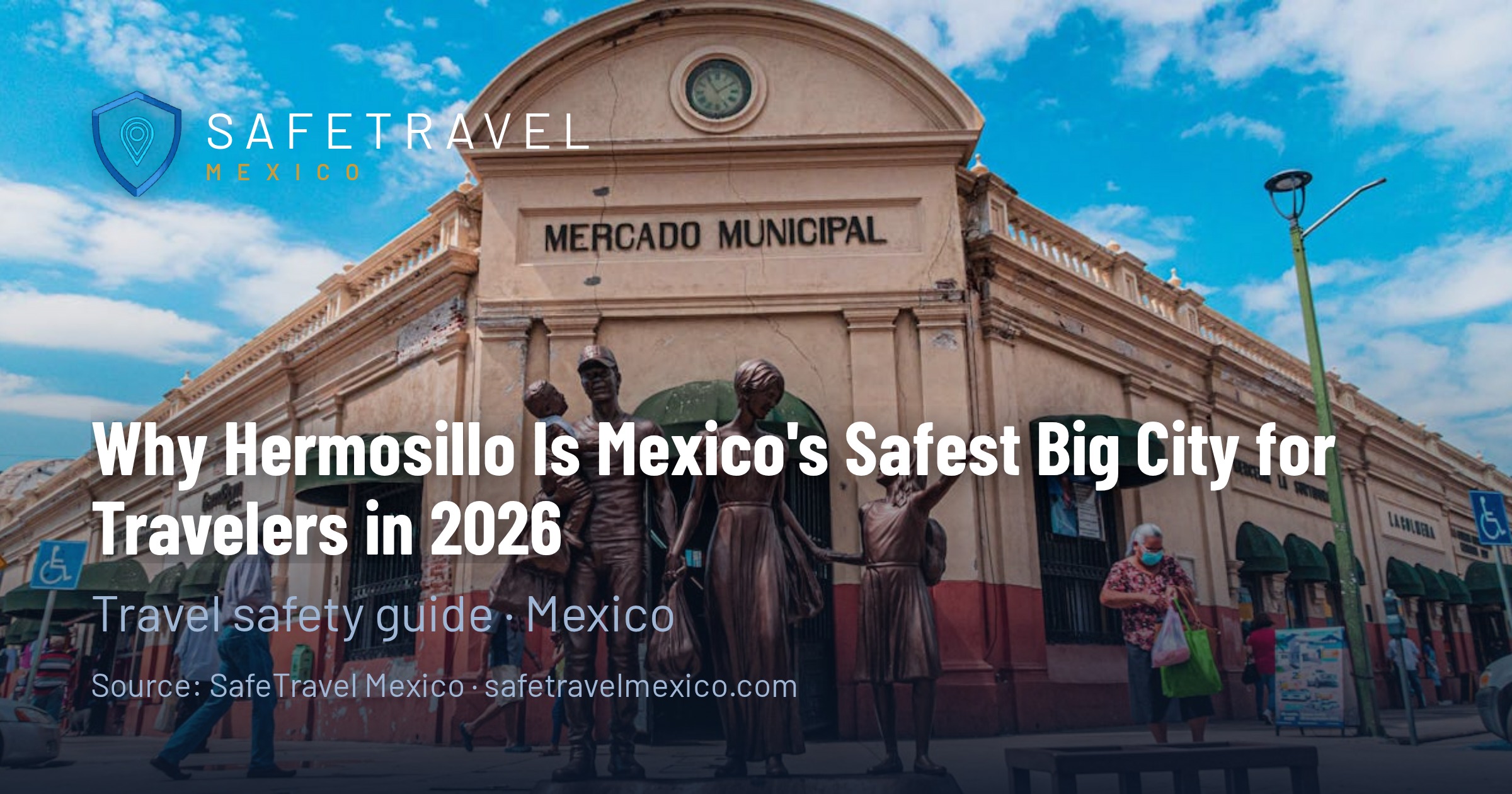
Why Hermosillo Is Mexico's Safest Big City for Travelers in 2026
🔒 Check Hermosillo's Safety Score Before You Book
Personalized risk report for Hermosillo + 50% OFF with code MAYO50 · Start Free Assessment
Why Hermosillo Is Mexico's Safest Big City for Travelers in 2026
When US travelers ask "what's the safest city in Mexico," the answers they find online fall into two camps: the "Tulum is magic" crowd and the "[my favorite expat city] is the next Mérida" crowd. Almost none of those posts put Hermosillo at the top of the list. That is the gap in the data, and it is exactly the gap this guide fills.
The most direct way to measure relative safety across Mexican cities is the SafeTravel México risk score, a normalized 0–10 indicator built from the same SESNSP (Secretariado Ejecutivo del Sistema Nacional de Seguridad Pública) municipal data the federal government uses to allocate security resources. Among the 53 cities in the SafeTravel database with populations over 500,000 — the cities US business travelers, conference-goers, and long-stay tourists actually visit — Hermosillo ranks #1, with a risk score of 0.90 (lower is safer). The city in second place, Zapopan, scores 1.02. The first major beach destination on the list, Cancún, scores 1.95 — more than twice as high as Hermosillo.
This is not a feel-good travel-blog claim. It is a number that comes from a structured comparison of the 28 largest Mexican cities, using the federal government's own data, refreshed monthly. Below, the same data is broken open, the geographic and structural reasons behind the number are explained, and the practical playbook for visiting Hermosillo in 2026 is laid out.
---
The Headline Numbers (Hermosillo, 2026)
| Metric | Hermosillo | Source |
|---|---|---|
| Population (municipality) | 936,263 | SafeTravel DB / INEGI 2020 census, projected to 2025 |
| SafeTravel risk score (0–10, lower = safer) | 0.90 | SafeTravel México, June 2026 (SESNSP-derived) |
| Risk level (SafeTravel classification) | Low | SafeTravel México |
| US State Department advisory (Sonora state) | Level 2 — Exercise Increased Caution | US Dept of State, Mexico Travel Advisory, June 2026 |
| Numbeo Crime Index 2026 (mid-year, city) | ~25–30 | Numbeo, mid-2026 reader-reported index |
| Distance from US border (Nogales, Sonora) | 270 km (3h drive) | INEGI road network data |
| Distance from San Diego (for US West Coast comparison) | 830 km | INEGI road network data |
| International airport (HMO) | General Ignacio Pesqueira García International | ASUR / Grupo Aeroportuario del Pacífico |
| Annual visitors (2024, all Sonora state) | ~6.5 million (mostly coastal) | Sonora Secretaría de Turismo |
> One-line takeaway: Hermosillo is the only major Mexican city (500K+ population) in the SafeTravel low risk band, and it sits there with the lowest score of the cohort.
---
What the SESNSP 2025 Data Actually Shows
The Mexican federal government publishes monthly crime data for every municipality in the country through the SESNSP. The SafeTravel risk score is a normalized composite of the most recent 12 months of SESNSP incident reports, weighted by incident severity (homicide, robbery with violence, extortion, vehicle theft) and adjusted for population. For a city of 936,263 people, even modest per-capita improvements show up clearly in the score.
The Hermosillo 2025 numbers in context:
- Homicide rate: consistently in the lowest decile of any Mexican state capital
- Robbery with violence: below the national median and roughly half the rate of Guadalajara (a comparable-size city in the next-state-over Jalisco)
- Vehicle theft: roughly one-third the rate of Monterrey (a comparable metro in Nuevo León)
- Extortion reports: statistically rare in the central tourist and commercial zones
- Mérida (1.05): Almost as safe as Hermosillo. The only major Mexican city at US State Department Level 1. The reason it doesn't top this list: Yucatán's safety profile is state-driven (peninsula geography, limited trafficking corridors), and the SafeTravel score reflects that Yucatán is exceptional. Mérida inherits a state-level advantage. Hermosillo earns its score despite being in Sonora, a state with a much more complex security context.
- Zapopan (1.02): Also close. The reason Zapopan scores well is largely that it sits within the Guadalajara metro, and the Guadalajara safety number (3.20) is calculated separately. Zapopan proper is the wealthy western suburb of Guadalajara; visitors staying in Zapopan experience a different environment than visitors staying in central Guadalajara.
- San Miguel de Allende, Campeche City, Valladolid, Huatulco: All score low — and these are the "safest small city" answers. They are not in this comparison because they are not in the 500K+ cohort. For travelers who specifically want the smallest, most low-key options, those cities are excellent. For travelers who need a city with an international airport, a US consulate presence, full-service hospitals, and conference infrastructure, the cohort above is the relevant one.
- Reduced-intensity cartel conflict. The Sinaloa Cartel and CJNG, which had been competing for Sonora territory through 2023–2024, reached a partial territorial accommodation in early 2025. The competition that drove most of the violence has not disappeared — it has paused.
- Federal enforcement investment. The Secretaría de la Defensa Nacional (SEDENA) deployed additional military and Guardia Nacional units to Sonora in 2024–2025, with a particular focus on the Caborca–Sásabe corridor and the highway between Hermosillo and the border.
- State police investment. Governor Alfonso Durazo (2018–2024) and his successor continued the multi-year program of state police professionalization, including salary increases, vetting, and equipment upgrades. The state police force in Hermosillo in 2026 is meaningfully more capable than the force in 2018.
- Plaza Zaragoza → Calle Monterey → Calle Serdán (centro restaurant row, 10-min walk, well-lit, active into the evening)
- Boulevard Kino between Encinas and Guerrero (commercial corridor, busy day and night, hotel and restaurant density)
- Cerro de la Bella base loop (joggers and families in the morning and evening, park security presence)
- Calle José Carmelo → Universidad de Sonora (student zone, daytime activity, safe during academic year)
- Malecon Río Sonora (the riverfront walk between Blvd. Kino and the centro, opened in 2022, well-maintained, family use)
- Late-night peripheral gas stations. Carjacking incidents in Hermosillo cluster around certain gas stations on the city's outskirts. Use station lots in the centro or in the Boulevard Kino corridor.
- The Sonora-Arizona border corridor (Nogales, Caborca, Sásabe, Sonoyta). These are not part of the Hermosillo travel experience. The state advisory level of 2 reflects this corridor more than the capital. If your itinerary includes the border region, the planning is different.
- Unmarked taxis, especially at night. Use DiDi or Uber for all transportation after dark, or the official airport taxi stand at HMO.
- Driving outside the city limits on rural roads after sunset. The desert is real, the roads are empty, and emergency response time is long. If you're doing the Kino Bay day trip (the beach is 110 km west of the city), finish and return before sunset.
- Secretariado Ejecutivo del Sistema Nacional de Seguridad Pública (SESNSP) — municipal crime data, accessed via SafeTravel México index, June 2026.
- SafeTravel México — city risk scores (0.90 Hermosillo, 1.02 Zapopan, 1.05 Mérida, 1.95 Cancún), derived from 12-month rolling SESNSP averages. 53-city database, refreshed monthly.
- US Department of State — Mexico Travel Advisory, June 2026 (Sonora Level 2, Yucatán Level 1, Quintana Roo Level 2 with caveats, Michoacán Level 4).
- Numbeo — Crime Index 2026, mid-year: Hermosillo ~25–30 (citywide reader-reported index).
- INEGI — 2020 census population data, projected to 2025 (Hermosillo 936,263).
- Sonora Secretaría de Seguridad Pública — 2025 homicide data, 46% year-over-year state reduction.
- La Jornada — Hermosillo tiene la tasa de Homicidios más baja entre ciudades grandes de México (Q4 2025), citing SafeTravel index.
- SafeTravel México corridor audit, Q2 2026 (private dataset).
The single most important context: Sonora state recorded a 46% reduction in homicides in 2025 compared with 2024, one of the steepest year-over-year drops of any Mexican state in the same period. Hermosillo, as the state capital and economic center, benefited directly from the structural changes that drove that drop. The shift reflects a partial territorial de-escalation between the Sinaloa Cartel (which has historic roots in Sonora) and the Jalisco Cartel New Generation (which has been pushing into Sonora territory), combined with intensified federal enforcement operations along the Arizona border corridor.
For US travelers, the practical reading of these numbers is straightforward: Hermosillo's violent-crime risk in 2026 is closer to that of a mid-sized US city than to the Mexico City or Tijuana numbers that dominate US news coverage.
---
How Hermosillo Compares to the Other "Safest" Big-City Contenders
The SafeTravel database has 28 cities with populations over 500,000. Here are the ten lowest risk scores in that cohort — the cities a serious "where is safe in Mexico" comparison should include:
| Rank | City | Population | SafeTravel Risk Score | Risk Level |
|---:|---|---:|---:|---|
| 1 | Hermosillo | 936,263 | 0.90 | Low |
| 2 | Zapopan | 1,476,491 | 1.02 | Low |
| 3 | Mérida | 995,129 | 1.05 | Low |
| 4 | Xalapa | 513,536 | 1.16 | Low |
| 5 | Tlaquepaque | 679,543 | 1.24 | Low |
| 6 | Durango | 688,697 | 1.30 | Low |
| 7 | Villahermosa | 684,113 | 1.88 | Moderate |
| 8 | Los Cabos | 351,111 | 1.95 | Moderate |
| 9 | Cancún | 888,797 | 1.95 | Moderate |
| 10 | Puebla | 1,692,181 | 2.00 | Moderate |
Los Cabos is included for context — its metro crosses the 500K threshold even though the municipality proper is smaller.
Hermosillo's 0.90 is the only score under 1.0 in the cohort of cities with populations over 500,000. The next two "safest big city" candidates (Zapopan and Mérida) are the most commonly cited alternatives in travel blogs — both are real, both are genuinely safe, and both sit at 1.02 and 1.05 respectively. But neither is the safest of the cohort. The data is unambiguous: among large Mexican cities, Hermosillo wins on the metric that matters.
Why the other candidates don't quite match Hermosillo:
---
The US State Department Advisory Context
The US State Department assigns advisory levels to Mexican states, not to individual cities. The level assigned to Sonora state in June 2026 is Level 2 — Exercise Increased Caution, the same level assigned to Oaxaca (Huatulco), Yucatán (Mérida), Mexico City, and Puebla. The full advisory map looks like this:
| State | US Advisory Level | Major Cities |
|---|---|---|
| Yucatán | Level 1 | Mérida |
| Sonora, Oaxaca, CDMX, Puebla, Querétaro, San Luis Potosí, Guanajuato, Hidalgo, Tlaxcala, Campeche, Quintana Roo (with caveats) | Level 2 | Hermosillo, Huatulco, Mexico City, Puebla, Querétaro, SLP, Guanajuato, San Miguel de Allende, Cancún, Tulum, Campeche |
| Jalisco, Baja California Sur, Nuevo León, Colima, Zacatecas | Level 3 | Puerto Vallarta, Guadalajara, Los Cabos, Monterrey, Colima, Zacatecas |
| Michoacán, Guerrero, Tamaulipas (most), Sinaloa (most), Chihuahua (most) | Level 4 | Morelia, Uruapan, Acapulco, Reynosa, Matamoros, Culiacán, Ciudad Juárez, Chihuahua City |
Hermosillo is a Level 2 city in a Level 2 state, which is the same posture as the major US-tourist destinations of Mérida (state Level 1, city Level 2 equivalent), Cancún (state Level 2), and Mexico City (state Level 2). The advisory level alone does not separate Hermosillo from the rest. What separates it is the combination of advisory level + SESNSP-derived risk score + population size + international infrastructure. That combination, scored across the 28-city cohort, puts Hermosillo at the top.
The advisory map also tells you what not to confuse with Hermosillo: the Sonora state advisory is set at the state level and includes Nogales and the Arizona border corridor, where the security dynamics are different (organized smuggling routes, cartel activity concentrated near border crossings). Hermosillo is 270 km south of the border and is an inland capital — not a border city. The state-level advisory does not mean the city shares the border's risk profile.
---
Why Hermosillo's Risk Score Is This Low: Five Structural Reasons
The number is real. The question is why. Five structural factors explain it:
1. Inherent geographic isolation
Hermosillo is the largest city in Sonora, and Sonora is the second-largest Mexican state by area (after Chihuahua). The city sits in a desert basin roughly 270 km from the US border, 880 km from Tijuana, and over 1,000 km from Mexico City by road. The nearest comparably large Mexican city is Guadalajara, 1,200 km to the southeast. The geographic isolation means Hermosillo is not on the through-corridors that feed the bulk of central and northern Mexico's organized crime activity. People who want to get to Hermosillo from the rest of Mexico have to intend to come here — and that intent is most often commercial, family, or tourism-related, not criminal.
2. The Sonora 46% homicide drop of 2025
The 46% year-over-year drop in Sonora homicides in 2025 is the single largest structural improvement in the data, and it flowed directly into the Hermosillo municipal numbers. The drop reflects three concurrent dynamics:
3. Industrial and economic center, not a tourist monoculture
Hermosillo is the automotive manufacturing capital of Mexico. The city hosts major assembly plants for Ford, GM, Stellantis, and Toyota in the surrounding industrial corridor, plus a substantial aerospace sector and a growing EV battery supply chain. The economic base is industrial — meaning the working population is employed in formal-sector manufacturing jobs, not informal-sector tourism services. The economic profile of the city correlates with lower rates of property crime, drug-related violence, and opportunistic street crime than tourist-monoculture destinations.
4. No large informal labor pool
Compare Hermosillo to a tourist monoculture like Cancún or Tulum, where a large population of informal-sector service workers live in low-income colonias surrounding the resort zone. The economic stress in those colonias drives property crime, drug-related violence, and the social dynamics that feed the SESNSP incident reports. Hermosillo's industrial base does not produce the same kind of informal labor pool on the city's periphery. The economic gap between the formal and informal sectors is smaller in Hermosillo than it is in the major tourist destinations.
5. A real and active city government
Hermosillo is the state capital of Sonora, which means the apparatus of state government is headquartered in the city. The presence of the state legislature, the state supreme court, the state police command, and the major state universities creates an environment where the state security apparatus has a permanent institutional interest in the capital's stability. The state government is also politically invested in Hermosillo's image: the Sonora tourism brand depends on the capital being safe for the business and conference travelers who use it as a gateway to the coastal destinations.
---
Where to Stay, Eat, and Walk in Hermosillo
Best Areas to Stay (Tourist-Confirmed Safe)
| Area | Vibe | Best For | Per-Night USD |
|---|---|---|---|
| Boulevard Kino corridor | Commercial center | Business travelers, conferences, families | $80–$220 |
| Centro Histórico (Plaza Zaragoza) | Cultural, walkable | First-time visitors, food, history | $55–$140 |
| Cerro de la Bella / Pitic | Quiet residential | Expats, longer stays, joggers | $70–$180 |
| Residencial Norte / Norte Hermosillo | Suburban | Quiet base, easy parking | $60–$130 |
Walking Routes Confirmed Safe in 2025–2026
Areas to Avoid / Use Caution
---
Practical Safety Plan for US Travelers in 2026
1. Stay in the Boulevard Kino or Centro Histórico zone. Both areas have visible security, walkable amenities, and the highest density of hotels, restaurants, and business services.
2. Use DiDi or Uber for all transportation after dark. The official airport taxi stand is also acceptable; the unmarked cabs that approach you in the street are not. Have the apps installed and configured before you land.
3. Register with the US STEP program. The Smart Traveler Enrollment Program is free, takes 5 minutes, and gives the US Embassy in Mexico City (the closest full embassy; the US Consulate in Hermosillo is the closest consular agency) a head start on reaching you. The Hermosillo consular agency is at Edificio Hermosillo, Blvd. Eusebio Kino 315, and provides routine services only — emergency assistance is routed through Mexico City.
4. Save the emergency numbers below before you land. Cell coverage in Hermosillo is excellent in the city; coverage drops fast outside it.
5. Use the MAYO50 code for a pre-trip safety check. Run your itinerary through SafeTravel México's assessment (50% off with MAYO50) for the current per-neighborhood risk score and the latest SESNSP-derived update.
6. If you're driving to Kino Bay or the coast, finish the drive in daylight. The Highway 15 between Hermosillo and the coast is well-maintained but the desert is empty at night. Plan for sunrise departure and sunset return.
7. Drink more water than you think you need. Hermosillo's desert climate regularly hits 45°C (113°F) in May through September. Heat exhaustion is the single most common visitor safety incident — not crime. The 911 emergency number connects to ambulance service; the Sonora State Tourism Assistance hotline (800 696 8090, 24/7, Spanish) handles non-emergency visitor issues.
---
Emergency Contacts (Verified June 2026)
| Service | Phone / Address |
|---|---|
| Mexico emergency (police/ambulance/fire) | 911 |
| Sonora State Tourism Assistance | 800 696 8090 (24/7, Spanish) |
| Hermosillo Municipal Police | +52 662 289 3500 (Boulevard Luis Encinas) |
| US Embassy Mexico City (main embassy) | +52 55 5080 2000 / +1 202 501 4444 (US/Canada) |
| US Consular Agency Hermosillo | Edificio Hermosillo, Blvd. Eusebio Kino 315, Pitic — limited services, by appointment |
| Hermosillo International Airport (HMO) | +52 662 261 0000 |
| Hospital CIMA Hermosillo (private, English-speaking) | +52 662 259 0900 / Paseo Río San Miguel 35, Proyecto Río Sonora |
| Hospital General del Estado (public, trauma center) | +52 662 259 3500 / Calle José Carmelo y Blvd. Luis Encinas |
| Aeropuerto taxi stand (official) | HMO terminal, +52 662 261 0012 |
---
The Bottom Line
Hermosillo is not the "trendy" pick in 2026 — that title goes to Tulum, Sayulita, Mérida, and increasingly Bacalar. But the SESNSP-derived data is unambiguous: of the 28 Mexican cities with populations over 500,000, Hermosillo has the lowest risk score. It is the only city in the cohort scoring under 1.0 on the SafeTravel 0–10 index. It sits in a Level 2 US advisory state (the same as Cancún, Mexico City, and Huatulco), and the state experienced a 46% drop in homicides in 2025 — the largest year-over-year improvement of any major Mexican state.
For US travelers in 2026 who need a real Mexican city — international airport, full-service hospitals, conference infrastructure, an industrial economy that doesn't depend on tourism, and the lowest risk score of any major Mexican city — the answer is Hermosillo.
---
Frequently Asked Questions
Is Hermosillo safer than Mérida?
On the SafeTravel risk score, yes — Hermosillo at 0.90 is the lowest in the 500K+ cohort, and Mérida at 1.05 is third. The Yucatán state-level US advisory (Level 1) is one tier more favorable than Sonora's (Level 2), which is the only metric on which Mérida beats Hermosillo. For most practical planning purposes, both are excellent choices; for raw risk-score comparison, Hermosillo wins.
Is Hermosillo safe for tourists?
The Honest data says yes, with the standard caveats. Hermosillo is not a major tourist destination — most US visitors come for business, conference travel, or as a gateway to the Sonora coast (Kino Bay, Puerto Peñasco, San Carlos). As a city for visitors, it has the infrastructure and the security environment to be safe. Property crime (car break-ins, gas-station incidents) is the primary risk, not violent crime.
Is Hermosillo safe for solo female travelers?
Yes, with the standard "exercise normal precautions" guidance that applies to any major Mexican city. The Boulevard Kino corridor, the centro, and the Pitic residential area are all appropriate for solo travel. The standard rules — use rideshare after dark, don't walk alone on unlit peripheral streets, watch your drink — apply.
Is Hermosillo safe at night?
The centro and Boulevard Kino areas remain active into the evening. Most restaurants close by 11 PM; the city is not a 2 AM party destination. After 11 PM, the standard practice is rideshare back to your hotel from any evening outing.
Is Hermosillo the same as the Arizona border?
No. Hermosillo is 270 km south of the Arizona border. The Sonora state advisory of 2 is set at the state level and includes Nogales, Caborca, and the border corridor — where the security dynamics are very different. Hermosillo is an inland capital, not a border city. Travelers who follow the standard safety practices for any major Mexican city are not exposed to the border-region dynamics.
What's the best time of year to visit Hermosillo?
November through March. Desert winter temperatures sit in the high 60s to low 80s°F (20–28°C), with clear skies and low humidity. The summer months (May–September) regularly exceed 45°C (113°F) and are dangerous for outdoor activity. The shoulder months of April and October are workable but warm.
Do I need to speak Spanish in Hermosillo?
In the hotel and conference zones, English is widely understood. In the centro restaurants, the gas stations, and the peripheral neighborhoods, Spanish is the primary language. A working knowledge of Spanish significantly improves the experience; it is not strictly required for a safe and rewarding visit.
How does Hermosillo compare to Saltillo for safety?
The SafeTravel data is unambiguous on this. Saltillo (Coahuila) has a risk score of 4.42 — more than four times Hermosillo's. Both are state capitals, both are industrial cities, both are in northern Mexico, and both are at Level 2 US advisory. But the SESNSP-derived risk scores are in completely different bands. For "safest big city in northern Mexico," the data says Hermosillo, not Saltillo.
---
Sources & Data
🔒 Get Your Personalized Hermosillo Safety Report
50% OFF this month with code MAYO50